Handmade Pipe Organs
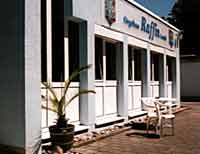 |
Terry has four street organs made by Orgelbau Raffin in Überlingen, Germany. Raffin wooden organ pipes produce a distinctly smooth flute sound. |
His mid-sized Raffin street organ was handcrafted for him in 1990. Its wooden pipes are arranged in three 16 pipe ranks of melody pipes, each with a different sound quality, a rank of small wooden piccolo pipes,10 tenor pipes and 5 octave pairs of bass pipes for a total of 84 pipes.
Terry also has a larger organ made in 2007, (not pictured here) with three 16 pipe ranks of wood melody pipes, 19 large wooden trumpet pipes, a rank of wooden piccolo pipes, and a rank of metal whistle pipes, plus the tenor pipes, and the 5 pairs of bass pipes for a total of 119 pipes..

|
 |
 |
 |
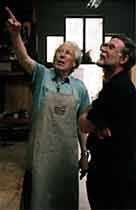
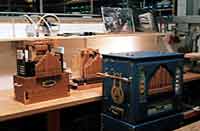
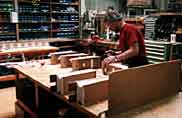
| Air is produced by turning the crank to pump a double bellows underneath the pipes. Here a craftsman is working on bellows for new organs. |
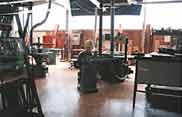
Raffin organ machine shop. |
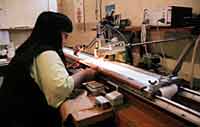 |
The organ plays music using punched paper rolls with tunes arranged especially for this type of street organ. This photo shows Raffin rolls being punched. New punching machines are computer controlled. |
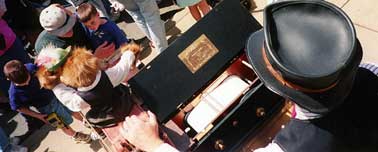
| When the punched paper roll is pulled across the 31 hole tracker bar, the holes in the paper release valves that allow the air into the appropriate pipes. When the organ grinder turns the crank, he pumps the bellows, pulls the paper across the tracker bar, controls the tempo of the music, and voices the music through the use of four (or six) stops that select the ranks of melody pipes. |
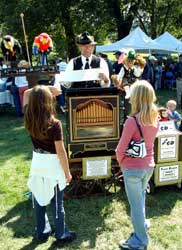 |
This organ is referred to as a "31-note" because there are 31 holes across the tracker bar. This organ has no electrical parts or electronic components. It weighs about 100 pounds and is on a special cart.
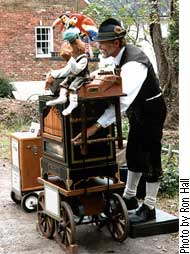 |
Although the notes are determined by the holes in the paper, the final sound, including tempo, smoothness of sound, and tonal variety (through selection and change of melody ranks with stops as shown in the photo), is up to the human organ grinder.
|
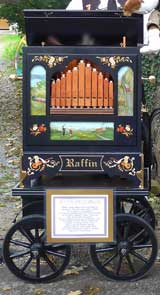
Terry's newest organ, hand-made for him in 2018, is called a "20 note" organ because the punched rolls have 20 holes or "notes" across the width of the paper.
This organ has six ranks of melody pipes, with 11 pipes in each rank. Two of the ranks have metal pipes and the rest are wood. Each melody rank has a different tonal quality. The organ also has 6 tenor pipes and 3 octave-pairs of bass pipes for a total of 78 pipes.
The case is inlaid with musical instrument designs and other decoration. There are three custom paintings of Swiss scenes (trains and alp horn players) as well as a special cart. |
 |
Terry's smallest Raffin street organ is also a “20-note” organ. It has one rank of 20 wooden pipes and a rank of 11 metal "whistle" pipes that are controlled by a stop. This organ also plays with punched paper rolls. Because this small organ, as well as the new one above, has only 20 notes, arranging music is a real challenge. Skilled arrangers in England and Germany are still arranging music for both sizes (ie. 31 note and 20 note) of street organs.
| For a type of volume control, his small organ also has a Lexan sliding window that can be inserted in the front and the top can be closed. The organ weighs about 25 pounds and can be carried on its leather strap. The crank can be positioned on the back, which is traditional, or on the side if the organ is being played while strolling. |
 |
Back to Top
|