A Short History of Organ Grinders
Performers seeking to earn a living by entertaining “on the street” have been around since streets were invented. Men playing mechanical organs turned by a crank first appeared about 300 years ago. The early organs were very small with only a few notes. They had been invented to teach canaries to sing, but enterprising individuals realized that they could take these organs outside and play them to earn money. Organs improved over the decades. They became bigger, and as more and more pipes were added, they became capable of playing complex melodies.
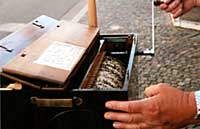
| Until the late 19th century, the organs used wooden barrels with pins or nails to carry the notes. As the barrel turned, the pins opened valves allowing air into the pipes. The air was provided by a bellows pumped by the same crank that turned the barrel. |
|
With a great deal of ingenuity in placing the pins, the creator of a large barrel could put 6 to 8 songs on the barrel. Since the barrels were not easily changed, the organ grinder walked the streets playing those same songs over and over again all day long. In the early days, the “popular” music often consisted of opera themes. From roughly 1890 to 1920, the Tin Pan Alley music publishers in New York utilized singing song pluggers and organ grinders to help market their songs.
...“ publishers worked closely with the manufacturers of the barrels that produced music in barrel organs, piano-organs, and street pianos, and with the instruments' owners, to ensure that these mechanical devices were furnished with the latest songs. Pluggers, in turn, paid the operators of the street instruments to play outside a theater after a performance featuring the song the plugger was pushing. In effect, street musicians commercialized the space outside the theater as plants and paid performers were commercializing it inside.”
[From Selling Sounds: The Commercial Revolution in American Music, by David Suisman, Harvard University Press, 2009. pg. 73.]
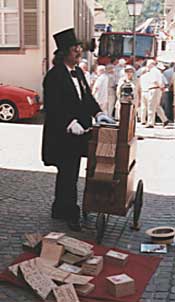 |
In the late 19th century, pneumatic organs using punched paper rolls or punched cardboard folding books began to replace the barrels. Punched paper was cheaper to produce than pinned barrels and offered a chance to play a much greater variety of music. All the organ grinder had to do was to put on a new roll or book.
The idea to use punched cards began in 1801 when Joseph Jacquard invented a loom that used a series of punched cards to weave a complex pattern of threads into cloth. The 1890 census was tabulated with punched cards. Punched card tabulation eventually led to the computers of today.
Punched paper rolls are still being produced today for the organs that are made in Britain and Germany. And, in this electronic age, it is even possible to get a small street organ that plays music using a changeable electronic packet. MIDI files accomplish digitally and electronically what piano rolls do mechanically. |
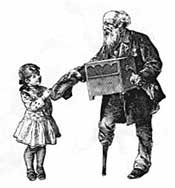 |
The organ grinder himself has been the subject of adoration as well as contempt. Until the invention of the phonograph and radio, the organ grinder brought the only music that many people, especially the poorer folks in cities, heard. That is why illustrations of organ grinders often show children or adults dancing around him. It might not have been great music, by today's audio standards, but it was a rare and desired commodity for many in those days. People gave the organ grinder coins to show their appreciation.
|
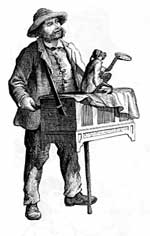
| Although the use of any animal would help attract attention, the monkey was often used because he had a thumb and could carry a cup to collect coins. Training the monkey to do this often involved what we would today consider to be cruel methods. However, it was possible for a man to support his family with enough hours on the street. |
 |
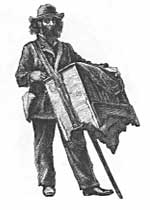 |
Organ grinders were also despised or even feared. The authorities in 17th and 18th century Europe were often afraid of itinerant musicians because they carried information and news from place to place, and they sometimes stirred up trouble. That is why organ grinders often had to obtain licenses to play. Sometimes the licenses were granted to disabled soldiers in lieu of pensions or medical care. Organ grinders were also disliked because they were typically foreigners or because they used small children in their acts. Often times, it must be admitted, the organ was not kept in tune and the music was just not very musical. |
There are very few organ grinders today who try to make a living at this activity anywhere in the world. Thus, the organ grinder you might see at a fair or band organ rally is there to entertain you with a bit a happy music and to keep alive interest in these old instruments and the music that they can produce.
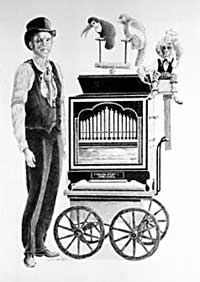 |
This drawing of Terry with his Raffin Street Organ and mechanical friends was done in graphite by the late art professor and artist Charles Ott who lived in Woodbridge, Virginia when he made this drawing. |

Back to Top
|














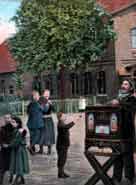 A handcolored photograph was used to make this postcard.
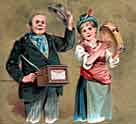 This postcard illustration reflects the not uncommon practice of the organ grinder's wife or companion playing tambourine as part of the street act.
 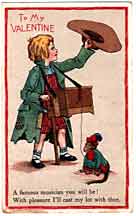 "A famous musician you will be! With pleasure I'll cast my lot with thee".